
What making offers
The Creator archetype stands for making, imagining and adding a personal touch. An idea has possibilities before it exists. Shaping it means choosing which of those possibilities receives a place in the finished thing.
The form can be ordinary: a recipe, a sentence, a repaired object or a changed arrangement. There is no required size or audience. Something does not need to become a large project to contain a real choice.
The interest also has different starting points. A proven pattern can leave one detail open. An existing object can be adapted. Making from the beginning offers another set of choices, rather than the only legitimate way to create.
A preference becomes something you can encounter
An imagined idea can keep several versions available at once. A made thing gives one version a definite shape. It can be used, seen, read or shared, which adds a different kind of experience.
That experience can teach something specific about the idea. A detail might matter more in use than it did in imagination. Another might turn out to need less attention. The thing itself gives the next choice something to respond to.
An idea can have several good endings.
When every possibility needs a place
A possible tension is letting the next idea reopen what the current version needs to be. There is always another colour, phrase or feature available. A useful version can still leave some of those choices unexplored.
Having another idea does not settle whether the existing version needs changing. The next question is what this particular thing is meant to offer. Some improvements serve that purpose; others begin a different project.
So finishing has a practical meaning. It can mean making a version ready to use, rather than exhausting every possibility. Later decisions remain open, and the current version is not incomplete just because more is possible.
A personal touch is not a permanent signature
Different purposes can deserve different versions. Something made for one occasion might look unlike something made for another. Both can contain deliberate choices without needing to repeat the same style.
This leaves room to borrow a useful structure or try a new form. The story's interest is in the shaping, rather than a rule that everything has to be new. A small adaptation can carry as much personal choice as a larger beginning.
Making room for someone else's part
A shared project contains choices that belong to different people. One person might care about the wording, another about the arrangement. Naming those preferences gives the group something more specific than a general wish to make it better.
There can be a part to shape yourself and a part to leave open. Another person's version might change the result in an unexpected way. That is one possibility within making together, rather than a verdict on the first idea.

Let the thing have a life outside the idea
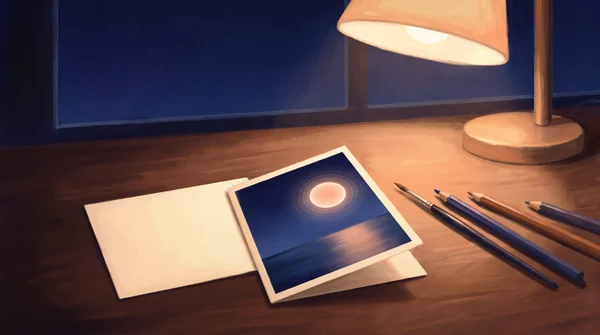
The finished card leaves the table. The drawing inside is simple, and another version could have contained more. But this version now belongs to the occasion it was made for. Its purpose has become something real.
The Creator story can end with something being used rather than perfected. More possibilities remain, but they do not all need this version as their home. Making has given one idea somewhere to exist.
A question to take with you
What does this version need to become, and what can belong to another version?
A small idea to try: Choose one small thing to make or adapt. Decide what counts as ready to use before adding another possibility.
Related stories
Common questions
Does this story say someone has creative talent?
No. It concerns the appeal of making and shaping. The exercise does not measure talent, originality or the quality of anything someone produces.
Can using something ready-made fit the Creator story?
It can be a starting point for a personal choice. Following, adapting and inventing offer different amounts of choice; they are not a ranking of people.
Finishing, showing your work and the kind of feedback that helps are also among the everyday topics in the personal guide. About the personal guide
See your own result
48 short statements. Your full result is free. No account needed.
Take the free archetype test